
Every cannabis product sold legally in Colorado carries a label with the same core information. You’ll find a potency statement, a batch number tying the product to its lab results, the license numbers of the businesses that grew and sold it, the net weight, a contaminant testing statement and a set of required warnings, along with a diamond-shaped universal symbol marking it as a THC product. Learning to read the label takes about five minutes and changes how you shop, mostly because the number everyone fixates on turns out to be the least reliable thing printed there.
The universal symbol
The diamond containing “!THC” is Colorado’s universal symbol, and it has to appear on the front of the package at a minimum of half an inch square, alongside the statement “Contains Marijuana. Keep out of the reach of children.”
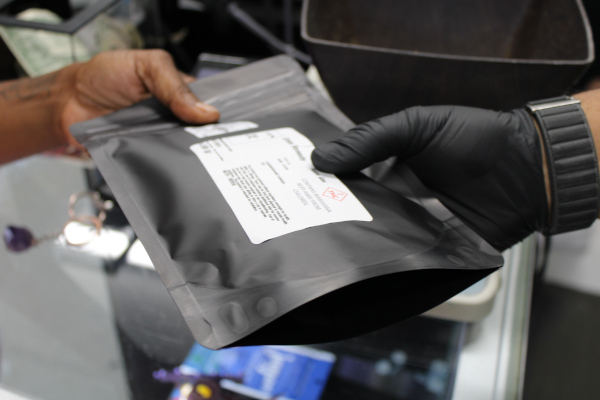
Its only job is instant recognition. If you’ve decanted something into another container at home, the symbol is what’s missing, which is a good argument for keeping products in their original packaging when there are kids, roommates or guests around.
The potency statement, and the 15% nobody mentions
Flower and concentrates list potency as a percentage of total weight. Edibles and drinks list it in milligrams, both per serving and per package, with retail servings capped at 10 mg of THC.
Here’s the part worth knowing. Colorado permits a variance on the tested potency figure, and the allowance runs to plus or minus 15 percent. A flower labeled 24% THC can legally test anywhere from roughly 20.4% to 27.6%. An edible labeled 10 mg per piece can legally land between 8.5 and 11.5 mg.
That variance is the reason chasing a one or two point difference between two labels is wasted effort. The gap between a 24% and a 26% flower sits comfortably inside the margin of error, so the two products may well be identical in practice or reversed. Potency tells you roughly which tier you’re in and very little more.
Total THC, THCA, and why the math matters
Raw cannabis contains very little delta-9 THC. Most of what’s in the plant is THCA, an acidic precursor that converts to THC when heat is applied, which is what happens when you smoke, vape or bake it.
Labs report both, and the label’s “total THC” figure combines them using a conversion that accounts for the weight lost during that reaction:
Total THC = (THCA × 0.877) + delta-9 THC
The 0.877 comes from the molecular weight difference between the two compounds. A flower testing at 25% THCA and 0.5% delta-9 THC reports total THC of about 22.4%.
This is useful in two directions. It explains why a label might show a low delta-9 number next to a high total, which is normal rather than a red flag. It also means that if you ever see a product advertising a THC figure that looks implausible for its category, checking whether someone simply added THCA and THC together without the conversion is a reasonable first guess.
Batch numbers and what they unlock
The harvest batch number, or production batch number for manufactured products, is the thread connecting your package to its laboratory results. Colorado requires everything to be tested by a licensed independent facility before sale, covering potency, microbials, mycotoxins, heavy metals and pesticides, with residual solvent testing added for concentrates.
Many producers now print a QR code linking to the full certificate of analysis for that batch, which is where you’ll find the complete cannabinoid breakdown and, often, the terpene profile. If there’s no QR code, the batch number and the producer’s website will usually get you there. The batch number is also what you’d reference if you ever needed to report a problem with a product.
License numbers, net weight and dates
The label carries license numbers for the cultivation facility, any manufacturer involved and the retail store. These are the audit trail, and they’re the reason legal products can be traced and unlicensed products can’t.
Net weight is recorded to a tenth of a gram and measured before packaging. If you bought an eighth, the label should read 3.5 grams or a little more. Our guide to cannabis weights covers what each size should weigh.
You’ll also find a date of sale, and for many products a harvest or production date. Flower is at its best within a few months of harvest when it’s stored properly, so a harvest date is worth a glance. An older date isn’t disqualifying, though it does make storage conditions matter more.
The contaminant testing statement
Colorado requires the package to state its testing status. A product that has passed contaminant testing says so, referencing compliance with the state’s mandatory testing rules. A product that has not been tested for residual solvents, mold and mildew has to carry the explicit statement that it hasn’t.
Read that line. It’s small, it’s easy to skip, and it’s one of the few places on the label where the difference between two products is categorical rather than a matter of degree.
Concentrates carry extra information
Concentrate labels add a solvent list, naming anything used in extraction. Solventless products such as rosin will show nothing there, which is the quickest way to confirm what you’re holding. Our concentrates guide explains what the different extraction methods actually produce.
Concentrate labels also include a statement of intended use, drawn from a fixed list the state maintains, which tells you whether a product is meant to be inhaled, taken orally, or applied to skin. Colorado also requires an educational resource pamphlet to be provided with every concentrate purchase, including a recommended serving size.
What the label does not tell you
Terpenes are frequently absent. Many producers publish the full terpene profile on the certificate of analysis or on the package voluntarily, and many don’t, so the aromatic compounds that shape a lot of the experience are often the thing you have to go hunting for.
The label also says nothing about how the plant was grown, how long it was cured, or how it’s been stored since leaving the facility. Two products with nearly identical labels can be noticeably different in the jar, and that difference comes from everything the label doesn’t capture.
How to actually use this when you’re shopping
Start with the category and the format rather than the number. Decide what you want and roughly how strong before you start comparing labels.
Treat potency as a tier instead of a score. Anything within a few points is effectively the same, and the 15% variance guarantees it.
Check the testing statement, then look for a terpene profile or a QR code if the aromatics matter to you. Glance at the harvest date on flower.
Then ask your budtender what the lab report doesn’t show. They’ve usually opened the product, and that’s information no label carries.
Browse the menu or check this week’s deals.
Frequently asked questions
What is the difference between live resin and live rosin?
Live resin is made using a solvent such as butane or propane. Live rosin is solventless, pressed from ice water hash with heat and pressure. Both start from fresh-frozen plants, and live rosin costs considerably more to produce.
Is distillate better than live resin?
Distillate tests higher for THC and costs less. Live resin keeps the plant’s original terpene profile, so it tastes markedly more like the strain it came from. Which is better depends on whether you’re buying for potency or flavor.
What does “live” mean in live resin?
The plants were flash-frozen at harvest instead of dried and cured, which preserves far more of the terpene content.
Are solventless concentrates safer?
Solventless products introduce no solvent that has to be removed. Colorado requires residual solvent testing on solvent-based concentrates before they can be sold, so both categories are tested before reaching the shelf.
What are cannabis diamonds?
Crystallized THCA, usually sold suspended in a terpene-rich sauce. The diamonds carry the potency and the sauce carries most of the flavor.
How much concentrate can I buy in Colorado?
Recreational customers can purchase up to 8 grams of concentrate per day, counted within the same overall daily limit as flower.
Does shatter mean it was made with a solvent?
Not necessarily. Shatter describes texture rather than process, though in practice most shatter on the market is solvent-based.
For adults 21 and older. This post is general information about Colorado labeling requirements and is not legal advice. Please consume responsibly and never drive under the influence.